The Challenge: Beyond Simple Copying
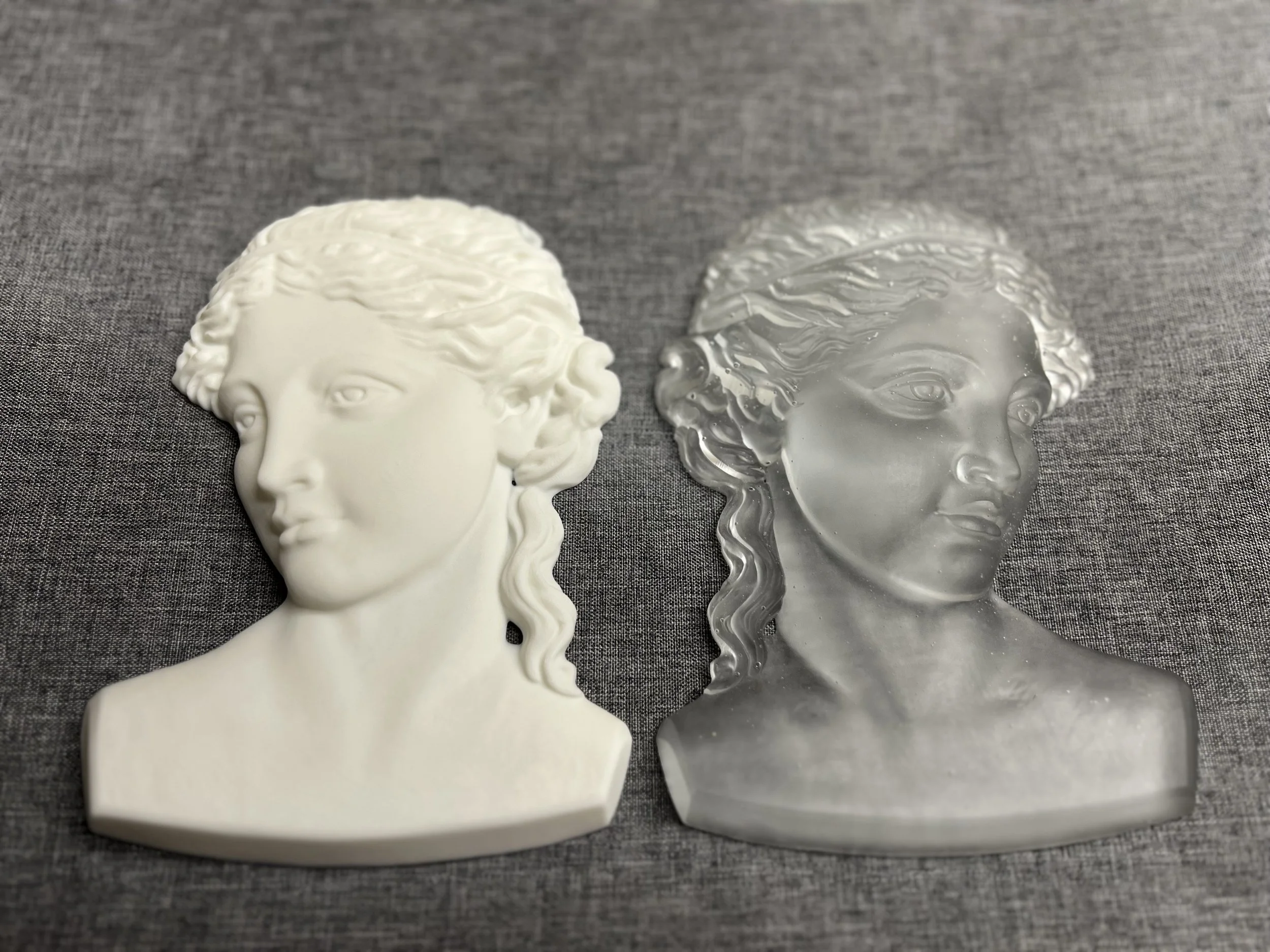
In the world of art and design, symmetry is often a silent protagonist. For this project, we started with a beautiful relief bust—a translucent, frosted piece that captured a serene classical profile. The goal wasn't just to replicate it, but to create its "other half."
By using 3D scanning technology, we were able to bridge the gap between a physical artifact and a digital workspace.
The Digital Workflow
High-Fidelity 3D Scanning: The original part (right) was scanned to capture the intricate details of the hair, the subtle curve of the brow, and the flowing drapery.
The Mirror Phase: Once the 3D mesh was cleaned, I applied a global mirror transformation. This allowed me to create a perfectly symmetrical version that would have been incredibly difficult to sculpt by hand with such precision.
From Virtual to Physical: The mirrored file was then sent to a 3D printer. As you can see in the results, the white filament provides a striking, marble-like contrast to the original’s frosted finish.
Why This Matters for Digital Heritage
This workflow isn't just for hobbyists; it’s a cornerstone of Museum Conservation.
Restoration: Replacing missing limbs or features on damaged statues.
Education: Allowing students to handle "physical" copies of delicate artifacts.
Creativity: Using existing forms to inspire new, symmetrical compositions.
Final Thoughts
The side-by-side comparison of the original frosted piece and the new matte-white print shows just how far desktop manufacturing has come. We are no longer limited by what we can find; we are only limited by what we can scan and imagine.